New Essex Police Headquarters
The ExecutionersNew Essex Police Headquarters is the principal civic setting in which the Bowden family's private danger becomes a matter for public authority. Adjoining City Hall, it appears as a practical center of policing rather than a dramatic fortress: a new wing, a compact office, gray files, a bullpen, and a barren waiting room. Yet the building's narrative significance comes from the tension between its orderly surfaces and the threat that presses against them. The family enters it seeking intervention against Cady, but the headquarters can offer only interviews, assessment, delay, and the uncertain machinery of law.
Setting and Physical Character
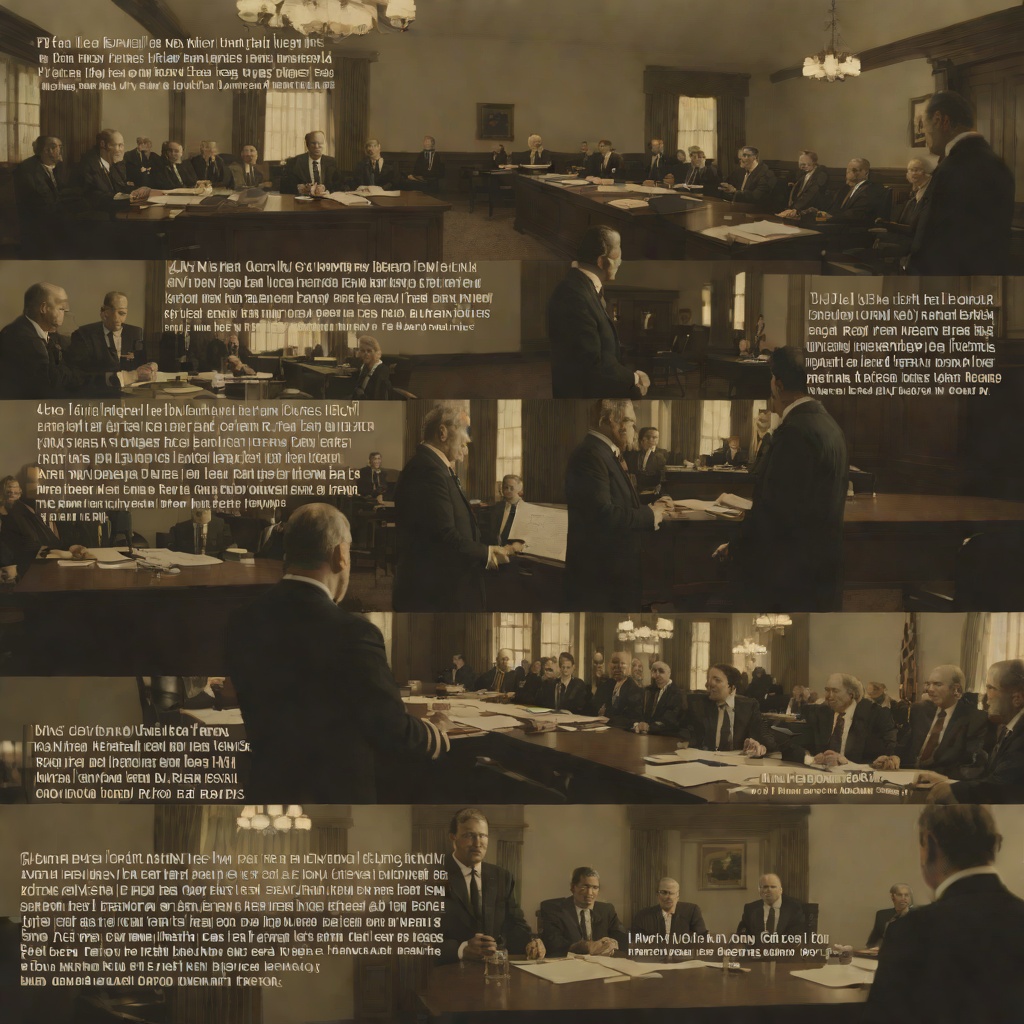
New Essex Police Headquarters adjoins City Hall, placing law enforcement directly beside the town's civic administration. Its visible order is institutional and impersonal. Captain Mark Button's office is in the new wing; a glass wall looks onto a bullpen in which more than half the desks are empty, while tall gray files line the walls. The details make the headquarters legible as a workplace designed for routine administration, not as a stage prepared for exceptional violence. The emptiness of the desks and the height of the files also give the setting a restrained sense of limited capacity: records and procedures are present, but the visible human force available to act is reduced.
Button himself reinforces that impression. He first appears as an ordinary-looking man in an ordinary gray suit, someone who might be mistaken for a broker, insurance agent, or advertising man until his direct, skeptical police gaze becomes apparent. The office therefore separates appearance from function. Nothing about the room announces heroism, but its occupant carries the weary wisdom of a professional accustomed to testing claims against evidence. The headquarters is consequently defined by institutional normality at the very moment when the Bowdens require something extraordinary.
The Family's Appeal to Authority
Sam Bowden deliberately converts his fear into an official request when, after rearranging his mail and shifting several appointments, he makes an eleven-o'clock appointment with Captain Mark Button. The scheduling is revealing: even under pressure, Sam approaches the crisis through the habits of an office worker and citizen. He does not arrive as an avenger but as someone trying to place an intolerable private threat inside an established public process. At headquarters, Button asks whether the visit concerns the same matter Charlie Hopper had previously raised, linking Sam's approach to an accumulating institutional record rather than an isolated complaint.
The building is also the endpoint imagined by the family when the danger becomes impossible to manage at home. After the family leaves the island in heavy rain, Nancy argues that it would be wiser to stay at a hotel in New Essex and that Sam and Carol should not leave; nevertheless, if they do, she says she can care for Jamie and Bucky and keep them out of trouble. Her judgment shows that the headquarters represents more than a police station. It is part of a wider civic strategy involving relocation, protection, and the dispersal of family members. The threatened household must decide not only whether to report Cady, but how much of its ordinary life can safely remain exposed.
Waiting, Delay, and Institutional Limits
The headquarters becomes most oppressive when Captain Mark Dutton is absent. Sam and Carol wait more than forty minutes before he returns, sitting in a barren and depressing waiting room. People passing through give them quick glances without curiosity or sustained interest. Carol sits woodenly, her face marked by hopelessness. The scene turns bureaucratic delay into an emotional event: the family's emergency is consuming their lives, but within the headquarters it is only one matter among many, temporarily suspended while the responsible officer is elsewhere.
This contrast between urgency and procedure deepens the location's ambiguity. The headquarters is where the Bowdens seek safety, yet the building cannot immediately deliver reassurance. Its waiting room produces the same suspended condition that has already governed their lives under threat: they are forced to wait, remain afraid, and depend on decisions made outside their control. The public institution has not necessarily failed, but its pace is radically misaligned with the family's experience of danger.
Private Fear in a Public Space
The headquarters gains force because the family's crisis has first been experienced through intimate conversation. Carol recognizes Sam's distraction after three increasingly absent days and reads his physical presence alongside his mental withdrawal. When he finally discloses the situation, she resents having been left to believe that everything was fine and objects to being treated as though she were a child. The headquarters stands at the far end of that movement from concealment to disclosure. What Sam tried to contain within marriage must now be carried into a room of files, interviews, and official scrutiny.
The same pressure reaches the children. Sam understands that the problem will not affect only him and Carol because the children lie within its orbit, while Nancy asks what he intends to do. Her question marks the failure of Sam's earlier role as the unquestioned head of a protected household. At headquarters, the family structure and the civic structure meet: Sam asks the police to do what he cannot do alone, even as the necessity of asking exposes his physical and moral insecurity.
Narrative Significance
New Essex Police Headquarters functions as a threshold between domestic responsibility and public power. Sam describes himself as a sedentary forty-year-old office worker with a mortgage, family, and insurance program, ill-suited to a new atmosphere of violence; he compares the mismatch to George Gobel entering a heavyweight Golden Gloves contest and imagines himself as a white mouse in a snake pit. The headquarters gives that metaphor an institutional setting. Sam's inadequacy is not merely personal weakness; it is the condition of a civilian trying to make an ordinary civic system answer an extraordinary menace.
At the same time, the location clarifies the novel's changing idea of action. Sam initially wants the authority of the police to absorb the danger, while his fear and Carol's breakdown make delay increasingly unbearable. Later, after the crisis has altered his sense of himself, he says that the world feels fresh and that his profession is only a tool, useful when it helps and replaceable when it does not. The headquarters belongs to the earlier belief that established tools can solve the problem. Its files, officers, and waiting room remain necessary, but their limits help explain why the family's struggle cannot be resolved by institutional procedure alone. In that sense, the building is less a secure refuge than a precise image of lawful order under pressure: present, rational, and insufficiently quick for the violence approaching from outside.